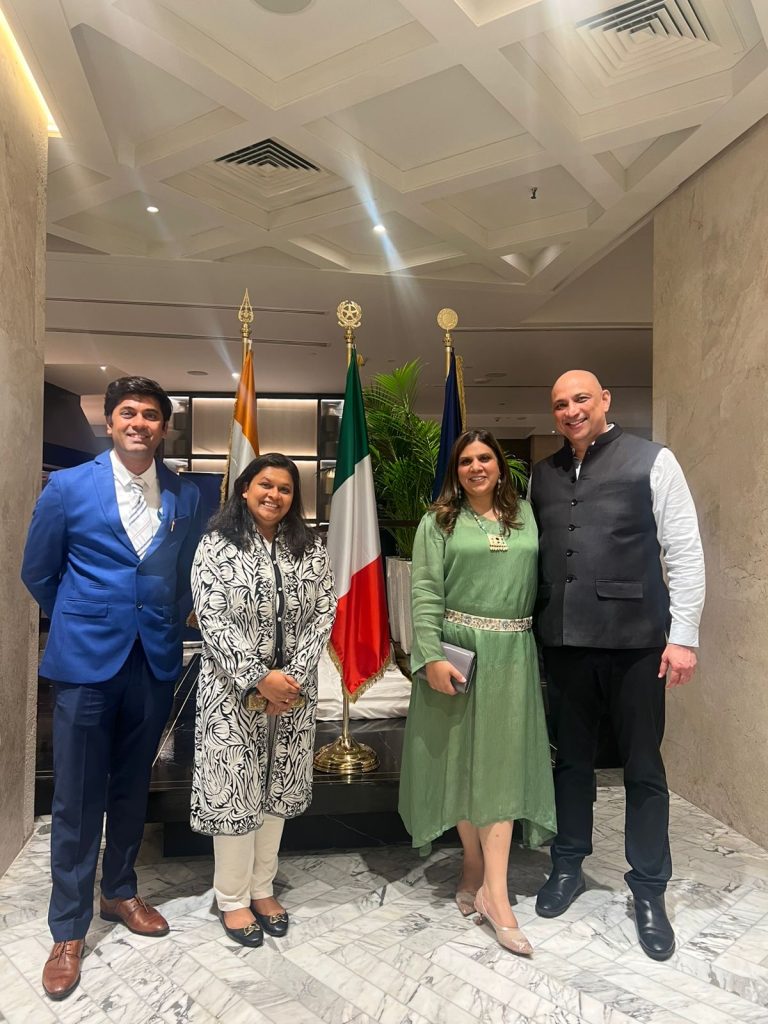
Recently, we had the privilege of attending the Italian Republic Day celebration hosted by the Consulate General of Italy in Bengaluru. While such events are often remembered for their hospitality and networking, what stood out most was something much deeper — meaningful conversations about the future of technology, innovation, and semiconductor ecosystem development.
As the semiconductor industry enters one of the most transformative decades in its history, it has become increasingly clear that no single company, university, startup, or even country can build the future alone.
Semiconductors are not built by fabs alone.
They are built by students willing to learn difficult concepts. They are built by professors who inspire curiosity. They are built by engineers who transform ideas into silicon. They are built by startups that challenge convention. They are built by industry leaders who invest in long-term innovation.
Most importantly, they are built by ecosystems.
During the event, we had the opportunity to discuss semiconductor workforce development, innovation programs, technology partnerships, and ecosystem enablement with leaders from industry, academia, and international organizations. The discussions reinforced a belief that has guided VLSI System Design (VSD) from the very beginning.
The future belongs to builders, not spectators.
For years, the semiconductor industry was often perceived as inaccessible. The tools were expensive. The learning curve was steep. Access to real silicon seemed limited to a select few organizations.
Today, that narrative is changing.
Open-source EDA tools, cloud-based design environments, RISC-V platforms, FPGA technologies, and collaborative silicon programs are making chip design more accessible than ever before. A motivated student sitting in a small town now has opportunities that were unimaginable just a decade ago.
This transformation is not merely technological. It is cultural.
The next generation of semiconductor innovators will emerge from communities that encourage experimentation, collaboration, and continuous learning. They will be engineers who are comfortable moving between software and hardware, between AI and silicon, between research and product development.
At VSD, our mission is to contribute to this transformation by enabling access to semiconductor education, design tools, hardware platforms, and real-world implementation opportunities. Every workshop, internship, FPGA platform, RISC-V initiative, and tapeout program we build is driven by a simple goal: reducing the distance between learning and building.
India stands at a remarkable point in its semiconductor journey. With growing industry participation, government initiatives, academic engagement, and global partnerships, the foundation is being laid for long-term success.
The opportunity before us is enormous.
The chips that power tomorrow’s AI systems, communication networks, healthcare devices, automobiles, and industrial infrastructure will be designed by engineers who are learning today.
To every student, researcher, professor, entrepreneur, and industry leader reading this:
The semiconductor future is not something we wait for.
It is something we build together.
And that future has already begun.