
Design Verification hackathon means what?

The working of digital computers, smartphones, etc all have some underlying basic logic manipulating just 0s and 1s to come up with interesting outcomes. With design specifications, we convert our idea into silicon.

The design process of achieving it starts with our specifications on hand, then modelling them using Hardware Description Languages (HDL) like Verilog which describes the functionality as code in RTL Level. The RTL is then transformed into a GDSII file (or OASIS file) automatically using EDA (Electronic Design Automation) tools. The verification of the logic is a must and can’t be done manually as the design complexity has been exploding for the past several decades. Test benches and test cases are developed to verify the correctness of the logic as per the specification.

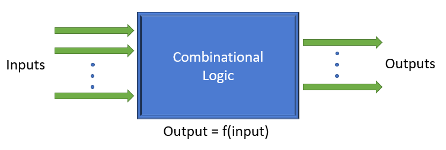
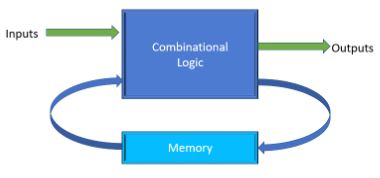
The circuit may be combinational i.e., which gives some output based on current input values or sequential where we include memory elements to make the output as a function of past output values.

A Generic combinational block is represented as
As an example, an adder circuit
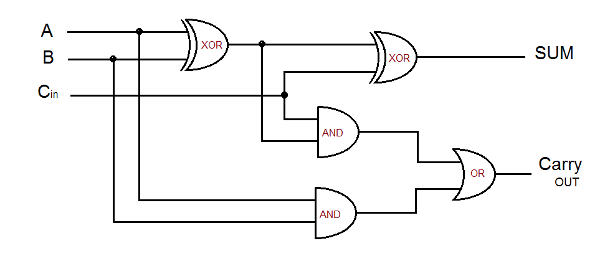
(Credit: https://theorycircuit.com/full-adder-circuit-diagram/)

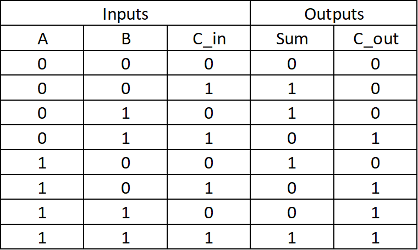
This circuit takes two input bits along with the carry bit from the previous stage of the adder(if it’s the first stage maybe we can take C_in as 0). The circuit performs the addition of two bits along with carrying and results in sum and carry out bits as per the truth table given below.
A Generic sequential circuit is represented as
A two-bit asynchronous counter is as shown
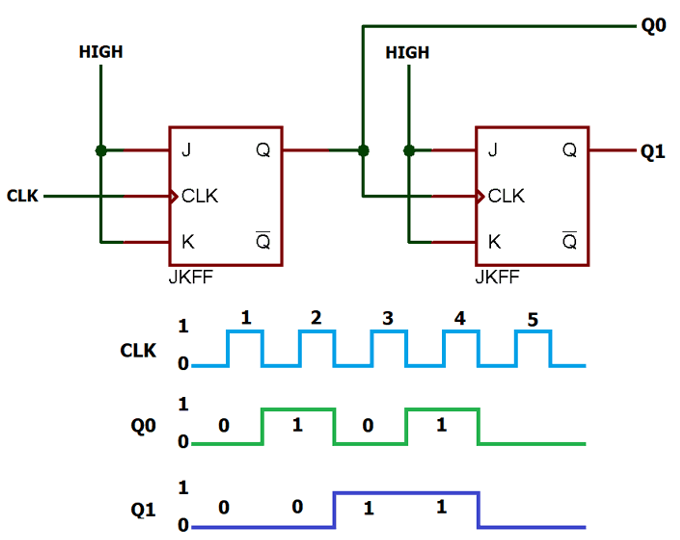
(Credit: https://circuitdigest.com/tutorial/asynchronous-counter)

This block counts 0, 1, 2, and 3 repeatedly. The JK Flip Flop with both inputs as HIGH results in toggling of the output as the circuit gets triggered.

Verilog is one of the many available HDLs used for modelling such circuits. Verilog makes logic blocks that implement one functionality as a module. The inputs and output from the logic design are named ports. The syntax for creating a module is as shown

module <module-name> (<module-port-list>);

//functionality description

endmodule

Design simulators are tools used to verify the intended functionality of the logic block. There are several design simulators both commercial and open-source available for simulating the Verilog designs. For example, Verilator, and Icarus Verilog are the open-source tools used to simulate the logic.

 Typically, the design was verified using test benches written again in Verilog. The test benches call to instantiate the design module and provide necessary test inputs exercising the module. The output signals are observed to see the values given by the design. The output is then compared to the reference model which gives the expected output. The comparison explains whether the design is performing as expected.

A sample Verilog code that implements full adder is as follows

module full_adder(

    input a, b, c_in,

    output sum, c_out

    );

    assign sum = a ^ b ^ c_in;

    assign c_out = (a & b) + (b & c_in) + (c_in & a);

endmodule

Verification of circuit design takes place by comparing the desired result with passing the test input to the device under test
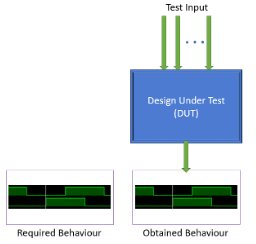
Full adders are simple and just require hardly a few minutes to test their functionality. Think of some complex circuits like code converters or finite state machines that do some complex tasks, which require many test cases to be tested upon. Manually verifying the logic by giving a set of inputs and comparing it with the expected one is tedious in this case because there are many different cases to test with a lot of input bits.

Use of verification tools (like Vyoma’s UpTickPro which is being used during the hackathon) can automatically give input and check for proper output and return a summary of the test. Now the verifier writes in a file the possible inputs and expected output. The tool will take up the design in HDL and provide input as mentioned and compare the output with the expected one and return a summary of the testing.

Are you excited to get hands-on with all the above tricks and techniques for FREE? Join the upcoming “Capture the Bug” hackathon and experience this exciting field by yourself

Hackathon details – https://nielithackathon.in/
Registration for Ethical RISC-V IoT Workshop

Welcome to Ethical RISC-V IoT Workshop

The “Ethical RISC-V IoT Workshop” at IIIT Bangalore, organized in collaboration with VSD, is a structured, educational competition aimed at exploring real-world challenges in IoT and embedded systems. Participants progress through three stages: building an application, injecting and managing faults, and enhancing application security. The event spans from May 9 to June 15, 2024, culminating in a showcase of top innovations and an award ceremony. This hands-on hackathon emphasizes learning, testing, and securing applications in a collaborative and competitive environment.

Rules :
  1. Only for Indian Student whose college is registered under VTU
  2. Only team of 2 members can Register
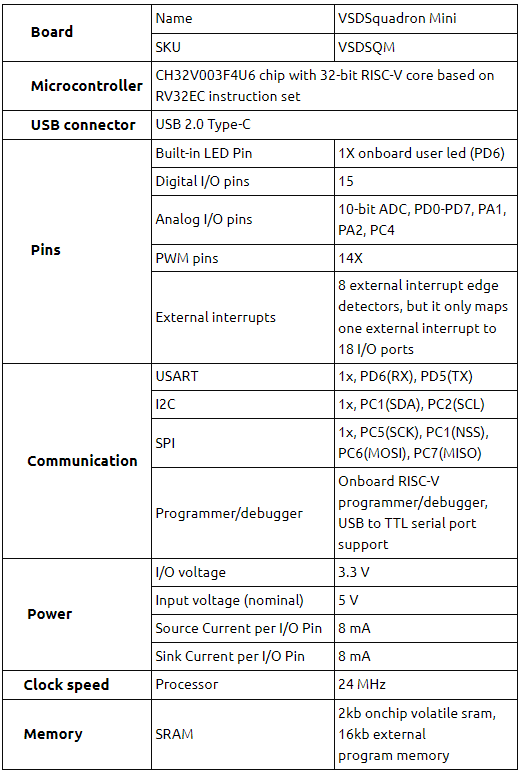
  3. Use only VSDSquadron Mini resources for product development
Awards :
  1. Prize money for final 10 Team
  2. 3 Winner team’s Product will be evaluated for Incubation
  3. 7 consolation prizes
  4. Completion Certificate to final round qualifier
  5. Chance to build a Proud Secured RISC-V Platform for India

Date for Registration : 9th May - 22nd May, 2024
Hackathon Inauguration : 23rd May 2024

VSDSquadron (Educational Board)

VSDSquadron, a cutting-edge development board based on the RISC-V architecture that is fully open-source. This board presents an exceptional opportunity for individuals to learn about RISC-V and VLSI chip design utilizing only open-source tools, starting from the RTL and extending all the way to the GDSII. The possibilities for learning and advancement with this technology are limitless.

Furthermore, the RISC-V chips on these boards should be open for VLSI chip design learning, allowing you to explore PNR, standard cells, and layout design. And guess what? vsdsquadron is the perfect solution for all your needs! With its comprehensive documentation and scalable labs, thousands of students can learn and grow together.

VSD HDP (Hardware Design Program) Duration-10 Week

With VSD Hardware Design Program (VSD-HDP),  you have the opportunity to push the boundaries of what exist in open source and establish the new benchmark for tomorrow.

It will leverage your degree in Electrical or Computer Engineering to work with

  • Programmable logic
  • Analog/ digital IP
  • RISC-V
  • Architecture & microprocessors
  • ASICs and SoCs on high-density digital or RF circuit cards
  • Gain hands-on knowledge during design validation and system integration.

Sounds exciting to just get started with expert mentors, doesn’t it? But we are looking for the next generation of learners, inventors, rebels, risk takers, and pioneers.

“Spend your summer working in the future !!”

Outcomes of VSD Online Research IP Design Internship Program

  1. Job opportunities in Semiconductor Industry
  2. Research work can be submitted to VLSI International journals
  3. Participate in Semiconductor International Conference with Internship Research Work
  4. Paper Publications in IEEE Conference and SIG groups
  5. Tape out opportunity and IP Royalty
  6. Interact with world class Semiconductor designer and researchers
  7. Academic professions where more research projects are encouraged.
  8. All the above research and publication work will help colleges and institutes to improve accreditation levels.

Know More Information

VSD – Intelligent Assessment Technology (VSD-IAT)

VSD – Intelligent Assessment Technology (VSD-IAT) is expertly built training platform and is suited for designer requirements. Semiconductor companies understand the value of training automation and Engineer performance enhancement, and do not need to be convinced of the impact of a virtual platform for learning. VSD trainings are quick, relevant, and easy to access from any device at any time zone.

VSD Intern Webinars

VSD Interns made it happen !!

VSD is working towards creating innovative talent pool who are ready to develop design and products for the new tech world. VSD believes in “Learning by doing principle” , and always prepare the student to apply the knowledge learned in the workshops, webinars and courses. We always push our students to work on new designs, test it and work continuously till it becomes the best performing design. Any student who enrolls to VSD community starts working with small design and grows with us and develops a tapeout level design with complete honesty and dedication towards the Work !!

Check out VSD Interns Achievement!

VSDOpen Online Conference

Welcome to the World’s only online conference in Semiconductor Industry VSDOpen Conference. With enormous support and global presence of audience from different segments of industrial lobby and academia made a highly successful event. Evolution is change in the genetic makeup of a population over time, online conference is one kind evaluation everyone adapt soon. 

  • VSDOpen 2022 is an online conference to share open-source research with the community and promote  hardware design mostly done by the student community.
  • VSDOpen 2022 is based on the theme “How to lower the cost to learn, build, and tapeout chips ?”  , which will provide a platform to community to build stronger designs and strengthen the future of Chip design.
  • VSDOpen is envisioned to create a community based revolution in semiconductor hardware technology.
  • The open source attitude is required to bring out the talent and innovation from the community who are in remote part of world and have least access to the technologies.  And now Google support will help to bring the vision to execution by VSD team

VSD Online Course by Kunal Ghosh

VSD offers online course in complete spectrum of vlsi backend flow from RTL design, synthesis and Verification, SoC planning and design, Sign-off analysis, IP Design, CAD/EDA automation and basic UNIX/IT, Introduction to latest technology – RISC-V, Machine intelligence in EDA/CAD, VLSI Interview FAQ’s.

Current Reach – As of 2021, VSD and its partners have released 41 online VLSI courses and was successfully able to teach  ~35900 Unique students around 151 countries in 47 different languages, through its unique info-graphical and technology mediated learning methods.

Enquiry Form