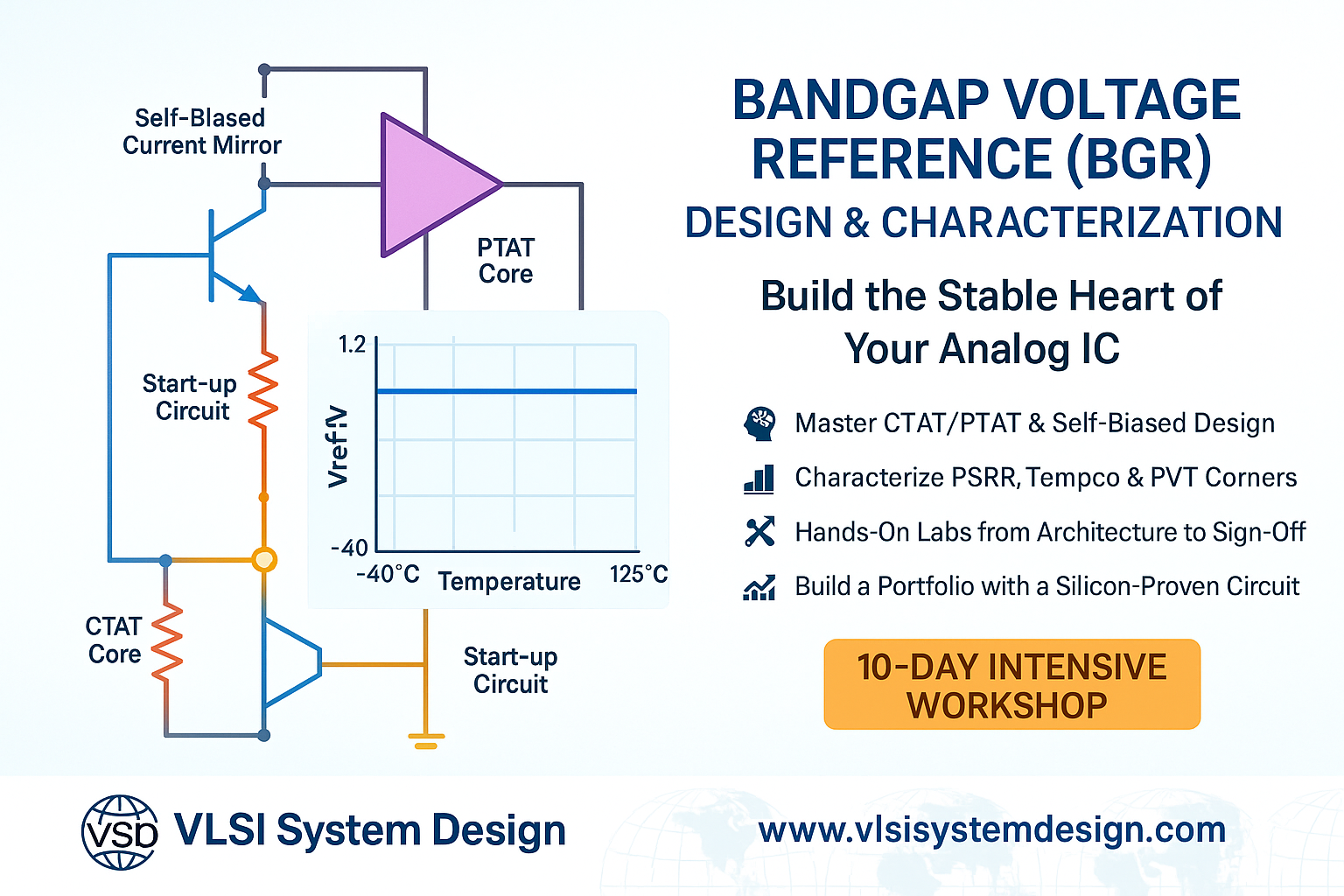
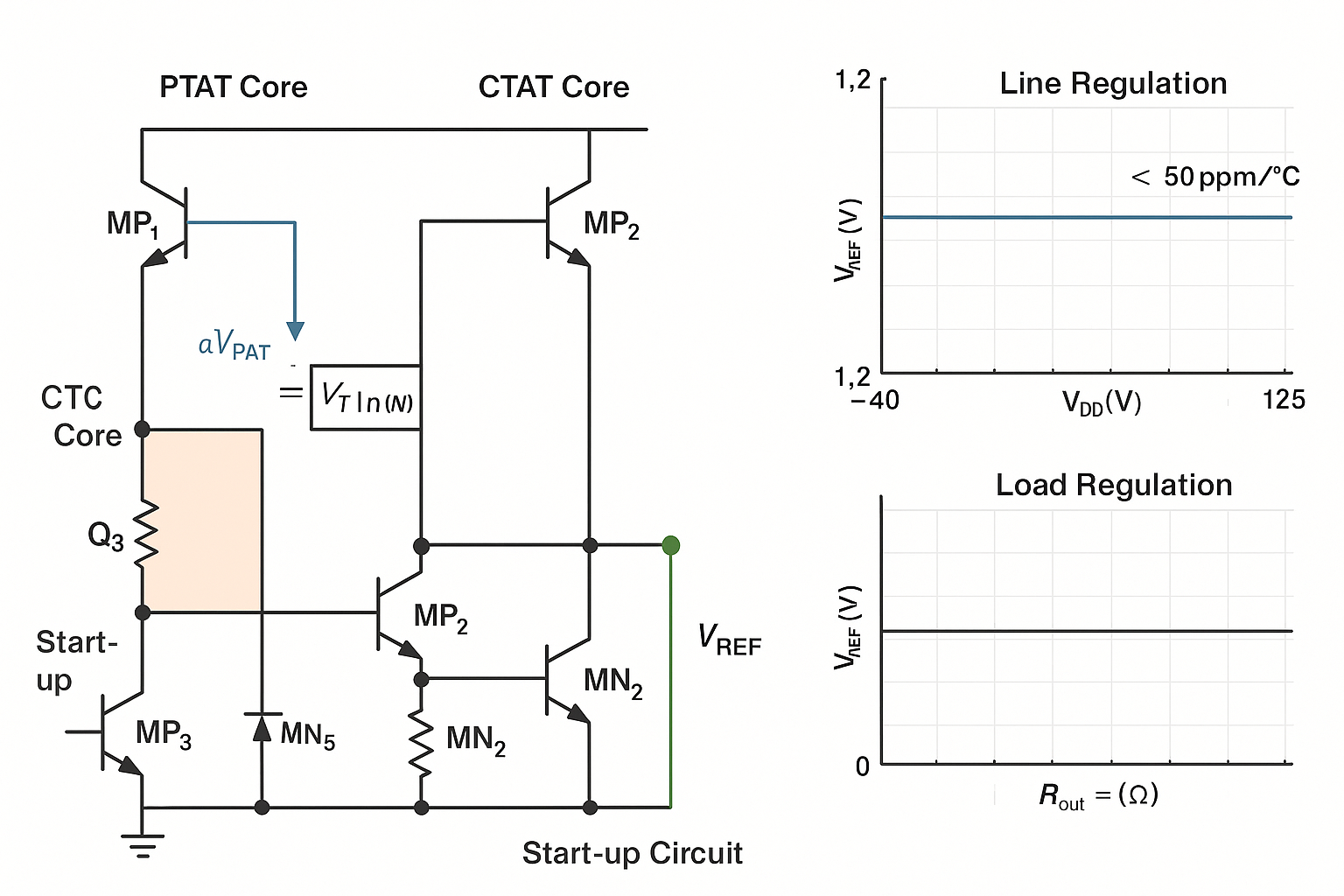
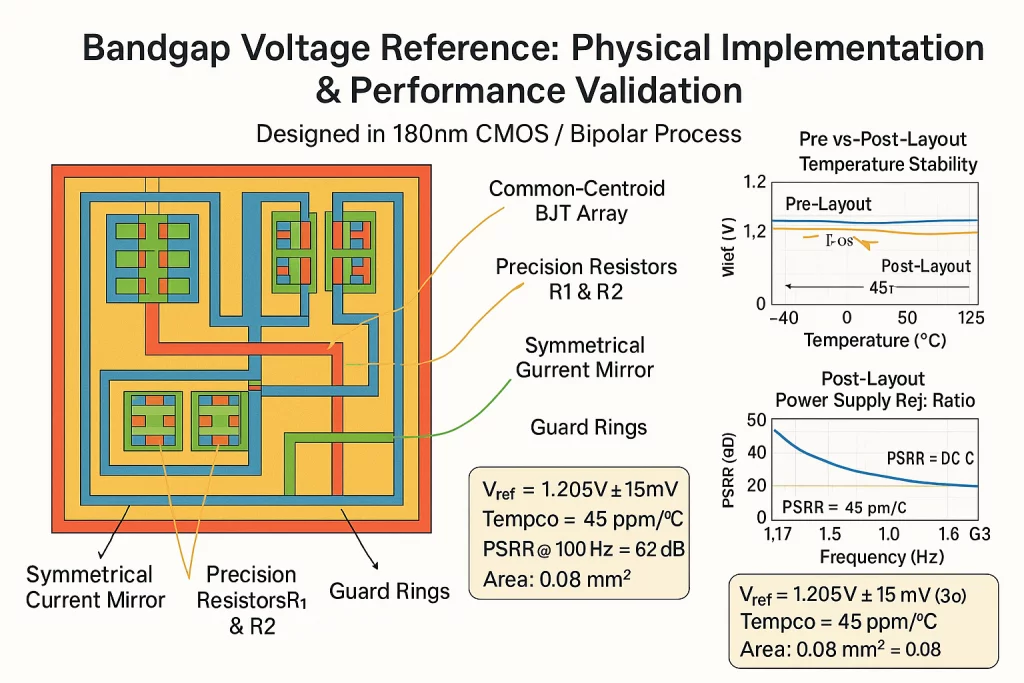

This ten-day intensive workshop builds professional analog IC design skills by guiding you through the complete design of a Bandgap Voltage Reference (BGR). Using a generic CMOS/Bipolar PDK, you’ll master the principles of CTAT/PTAT voltage generation, design a self-biased current mirror, implement a start-up circuit, and combine them to produce a stable 1.2V reference. You will characterize line regulation, load regulation, and temperature drift, run PVT corners, and produce benchmarked, publication-ready plots. Graduate with a validated BGR design methodology and a portfolio demonstrating core analog design competence.
Bandgap Voltage Reference (BGR) Design and Characterization is a hands-on workshop for mastering one of the most critical analog circuits. Built on industry-standard principles, you will work through the complete design flow: from architecture selection and component sizing to full-circuit simulation and verification. The curriculum emphasizes a deep understanding of BGR fundamentals, robust design techniques, and credible verification methods that meet international standards for research and product development.
You will begin at the component level with CTAT and PTAT voltage generation circuits, understanding the physics of bipolar transistors and the design of precision resistors. You will then construct and analyze a self-biased current mirror, tackling issues of supply independence and implementing a reliable start-up circuit. Each module includes practical calculations, pre-verified netlist templates, and measurement scripts to ensure you focus on design intuition rather than tool debugging.
The program culminates in the integration of a complete BGR circuit. You will simulate and analyze the final output for temperature stability (tempco), line regulation (PSRR), and load regulation. Guided by detailed specifications, you will run deterministic PVT corners (Process, Voltage, Temperature) to sign-off on the design’s robustness. Graduates leave with a coherent portfolio: annotated schematics, simulation results, and a comprehensive engineering report that demonstrates readiness for analog and mixed-signal design roles.

Kunal Ghosh, the visionary co-founder of VLSI System Design (VSD) Corp. Pvt. Ltd., stands at the forefront of online open-source EDA and hardware design education, particularly in the realm of RISC-V.
With a portfolio of 50 top-tier VLSI online courses, Kunal has enriched the learning journey of over 90,000 students across 153 countries. His expertise extends beyond training; he’s actively involved in pioneering open-source projects and design collaborations with esteemed institutions like IIT Madras, IIT Bombay, IIT Guwahati and IIT Hyderabad.
His current focus is on crafting high-quality open-source Analog/Digital IPs, a groundbreaking endeavor in open-source hardware design. Kunal’s rich industry experience includes roles at Qualcomm and Cadence, specializing in SoC design. He holds a master’s degree from IIT Bombay, where he specialized in VLSI & Nano-electronics, with a focus on sub-100nm Electron Beam Lithography Optimization techniques.

Dr. Santunu Sarangi is a seasoned analog/mixed-signal VLSI engineer with over a decade of industry experience, specializing in analog IP design, verification, and layout for advanced CMOS processes. He has successfully led development of voltage references, PLLs, ADCs and other precision analog blocks in production environments. With deep expertise in hands-on design flows and open-source PDKs, Santunu brings a strong blend of practical insight and teaching ability to guide participants through real-world analog IP development.

Yes. The entire workshop runs on a cloud hosted platform, so you can log in whenever it suits you, watch the day's lectures, complete the SPICE labs, and log out. Round the clock mentor support is available via WhatsApp, staffed by experts in multiple time zones throughout the ten day program.
Absolutely. Many analog and mixed-signal engineers use this workshop to deepen their understanding of BGR design trade-offs, master robust start-up circuit techniques, and adopt a methodical PVT verification methodology. The content is foundational yet deep, covering architecture choices, component sizing, and advanced stability analysis. You'll leave with a reinforced skill set directly applicable to precision analog circuits.
Yes---if you have a solid grasp of the pre-requisite basic electronics. We assume knowledge of transistors and basic circuit analysis. With that foundation, our step-by-step guides, template netlists, and dedicated mentor support will help you complete every exercise, from the CTAT core to the final characterized BGR.
Workshop videos, notes, and netlist templates remain available for the full ten day window. Because this is an industry oriented, time boxed sprint, all graded lab submissions must be completed within those ten days to qualify for certification.
No. All simulations run on a pre-configured virtual environment that you'll access on day one using a lightweight VDI client. After the workshop, we provide all netlists and scripts so you can run the simulations on your personal system if desired.
Industry recognition comes from focusing on a fundamental, universally used analog block. You will learn a complete design and verification flow for Bandgap Reference, a critical component in nearly every analog and mixed-signal IC. The skills in bias generation, temperature compensation, and PVT analysis are directly transferable to industry roles. The final certificate and portfolio project serve as tangible evidence of your capabilities to recruiters and hiring managers.
Cloud based Workshop
VSD, standing as a trailblazing Semiconductor EdTech company and a community-based Technology Aggregator, is revolutionizing the landscape of VLSI Design. With the belief that “Creativity is just connecting things”, VSD has mastered the art of linking the right resources with the community. This unique approach has sparked a significant transformation in the VLSI Design process.
Over the past decade, VSD has made remarkable strides in the open-source semiconductor domain. Our journey includes the development of comprehensive training content, empowering students to design silicon-grade IP/SoC. Notably, we’ve successfully guided these projects through the tapeout cycle via the Google open shuttle program. This achievement is a testament to our commitment to hands-on, practical education.
At VSD, our role extends beyond traditional education. While we didn’t invent EDA tools or design flows, we’ve made them accessible to a wider community. Our mentorship has been instrumental in the development of over 50+ Analog/Digital IPs and solutions. Impressively, 20+ of these have successfully transitioned from concept to Silicon – a clear indicator of our effective approach and the high quality of work produced under our guidance.
We pride ourselves on fostering a community-based revolution in the Semiconductor Industry. By democratizing access to advanced tools and knowledge, VSD is not just educating individuals; we are building a community of innovators poised to lead the next wave of advancements in the semiconductor sector. With VSD, the future of VLSI Design is not just being written; it’s being rewritten by a passionate and empowered community.
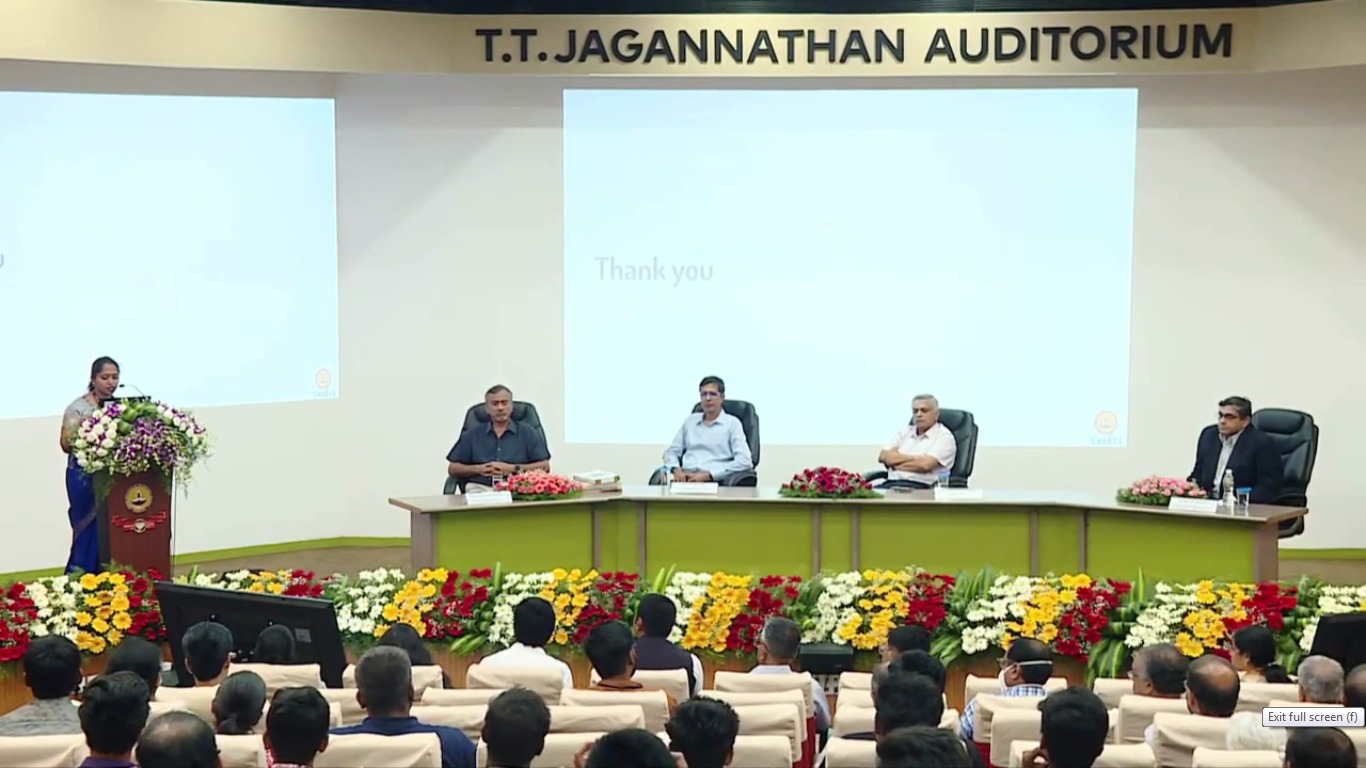
VSDSquadron was launched by Prof. V. Kamakoti, Director of IIT Madras

VSD Launches VSDSquadron In Collaboration With IIT Madras & DIR-V

Job Roles, Convergence With Embedded Systems, and Startups
VSD showcased at Semicon India 2023

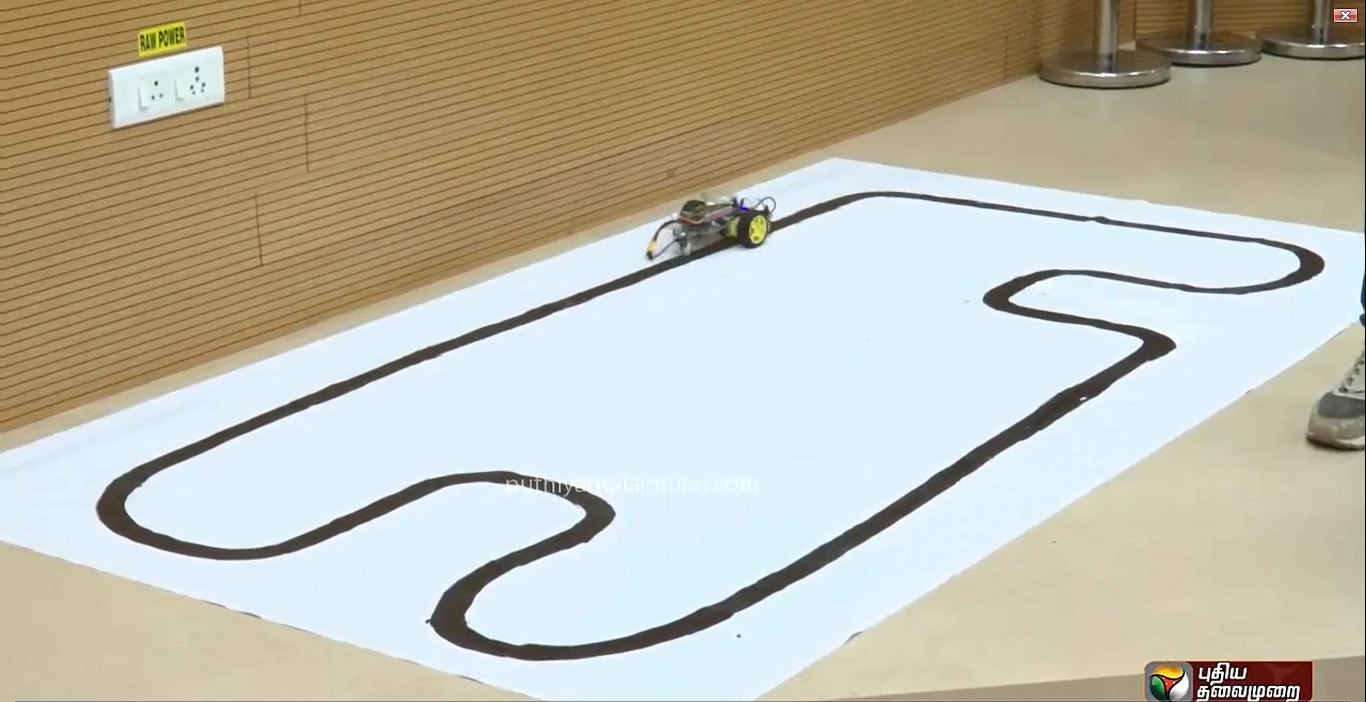
VSDSquadron Educational board on Tamil News channel

5 Day Workshop on VLSI Design Flow using RISCV and EDA Tools

Karnataka VLSI roadshow at Sahyadri College, Mangalore
Welcome to Ethical RISC-V IoT Workshop
The “Ethical RISC-V IoT Workshop” at IIIT Bangalore, organized in collaboration with VSD, is a structured, educational competition aimed at exploring real-world challenges in IoT and embedded systems. Participants progress through three stages: building an application, injecting and managing faults, and enhancing application security. The event spans from May 9 to June 15, 2024, culminating in a showcase of top innovations and an award ceremony. This hands-on hackathon emphasizes learning, testing, and securing applications in a collaborative and competitive environment.
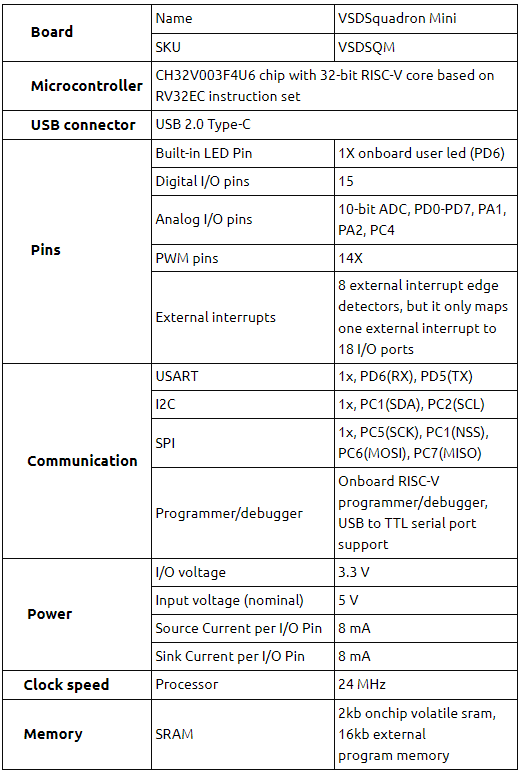
VSDSquadron, a cutting-edge development board based on the RISC-V architecture that is fully open-source. This board presents an exceptional opportunity for individuals to learn about RISC-V and VLSI chip design utilizing only open-source tools, starting from the RTL and extending all the way to the GDSII. The possibilities for learning and advancement with this technology are limitless.
Furthermore, the RISC-V chips on these boards should be open for VLSI chip design learning, allowing you to explore PNR, standard cells, and layout design. And guess what? vsdsquadron is the perfect solution for all your needs! With its comprehensive documentation and scalable labs, thousands of students can learn and grow together.
With VSD Hardware Design Program (VSD-HDP), you have the opportunity to push the boundaries of what exist in open source and establish the new benchmark for tomorrow.
It will leverage your degree in Electrical or Computer Engineering to work with
Sounds exciting to just get started with expert mentors, doesn’t it? But we are looking for the next generation of learners, inventors, rebels, risk takers, and pioneers.
“Spend your summer working in the future !!”
Outcomes of VSD Online Research IP Design Internship Program
VSD – Intelligent Assessment Technology (VSD-IAT) is expertly built training platform and is suited for designer requirements. Semiconductor companies understand the value of training automation and Engineer performance enhancement, and do not need to be convinced of the impact of a virtual platform for learning. VSD trainings are quick, relevant, and easy to access from any device at any time zone.
VSD is working towards creating innovative talent pool who are ready to develop design and products for the new tech world. VSD believes in “Learning by doing principle” , and always prepare the student to apply the knowledge learned in the workshops, webinars and courses. We always push our students to work on new designs, test it and work continuously till it becomes the best performing design. Any student who enrolls to VSD community starts working with small design and grows with us and develops a tapeout level design with complete honesty and dedication towards the Work !!
Check out VSD Interns Achievement!
Welcome to the World’s only online conference in Semiconductor Industry VSDOpen Conference. With enormous support and global presence of audience from different segments of industrial lobby and academia made a highly successful event. Evolution is change in the genetic makeup of a population over time, online conference is one kind evaluation everyone adapt soon.
VSD offers online course in complete spectrum of vlsi backend flow from RTL design, synthesis and Verification, SoC planning and design, Sign-off analysis, IP Design, CAD/EDA automation and basic UNIX/IT, Introduction to latest technology – RISC-V, Machine intelligence in EDA/CAD, VLSI Interview FAQ’s.
Current Reach – As of 2021, VSD and its partners have released 41 online VLSI courses and was successfully able to teach ~35900 Unique students around 151 countries in 47 different languages, through its unique info-graphical and technology mediated learning methods.